

DevOps
The 24-Hour Clock: What EU CRA’s September 2026 Reporting Deadline Means for Your DevOps Pipeline
There’s a regulatory deadline most DevOps teams have not internalised yet. On 11 September the clock starts.

There’s a comforting story circulating in European tech leadership circles right now: that the EU AI Act got delayed, that the August 2026 deadlines were pushed back, and that engineering teams have until 2027 — or even 2028 — to worry about compliance.
That story is partly true. And partly very, very wrong.
On 7 May 2026, after the Digital Omnibus trilogue nearly collapsed at the end of April, EU lawmakers reached a political agreement that does push significant chunks of the AI Act later. New or substantially modified Annex III high-risk systems (recruitment tools, credit scoring, biometric identification, critical infrastructure AI) now have until 2 December 2027. AI embedded in regulated products under Annex I has until 2 August 2028. National AI regulatory sandboxes have been pushed back by a year. For the headlines, it looks like a meaningful reprieve.
But the headlines are missing what is still happening on 2 August 2026 — roughly ten weeks from now. The provisional agreement explicitly leaves four hard deadlines untouched. Article 50 transparency obligations apply. AI Act enforcement formally begins. Article 5 prohibited practices remain in force. Database registration for exempted high-risk systems was reinstated after the Commission tried to remove it. And the agreement itself isn’t even law yet — it requires formal adoption by the Council and Parliament before it appears in the Official Journal.
For most European tech companies, this is the worst kind of regulatory situation: enough movement to create the impression of a delay, not enough movement to actually shift the work that has to be done. And the engineering work to comply with Article 50 alone is non-trivial — visible disclosure UI, machine-readable provenance metadata, watermarking infrastructure, documented user consent flows, and audit trails for everything.
Ten weeks. Let’s look at what actually needs to be in place.
Before getting into the engineering audit, it’s worth being precise about what stayed and what moved, because the political messaging has muddied this considerably.
Still applies from 2 August 2026:
– Article 50 transparency obligations (all four categories — chatbot disclosure, AI-generated content labelling, deepfake labelling, emotion recognition and biometric categorisation notice)
– Article 50(2) watermarking for AI-generated synthetic content — with a transitional period until 2 December 2026 for systems already on the market by August
– AI Act enforcement formally begins from this date — the legal framework moves from theory to enforceable practice
– Article 5 prohibited practices remain entirely intact (no negotiation on these)
– Database registration for exempted high-risk systems was reinstated under the 7 May agreement (this is important — the Commission tried to remove it and was overruled)
– Penalties framework becomes applicable
Moved to 2 December 2027:
– New or substantially modified Annex III high-risk system obligations (risk management systems, technical documentation, conformity assessments, human oversight, accuracy/robustness/cybersecurity requirements)
Moved to 2 August 2028:
– Annex I high-risk obligations (AI as products or safety components governed by EU product safety legislation)
Already in force since 2 August 2025:
– GPAI (general-purpose AI) model obligations — these are unaffected by everything above
Three crucial caveats matter here. First, the 7 May agreement is provisional. It still requires formal adoption. Until then, the original AI Act text remains the baseline law, and engineering teams should plan against current law rather than the proposed deferral. Second, Article 50 applies to every AI system that falls into one of its four categories — it doesn’t depend on high-risk classification. A simple chatbot in your customer support flow triggers Article 50(1). An image generator in your marketing tools triggers Article 50(2). Most teams have more in scope than they realise. Third, the transitional period for AI-generated content watermarking (the four-month extension to December 2026) only covers systems already on the market by 2 August 2026. New systems deployed after that date must comply from day one.
This is the part most companies haven’t done the work on yet. Article 50 has four distinct obligations, each with its own engineering implications.
Article 50(1) — Chatbot and direct-interaction disclosure. Any AI system that interacts directly with natural persons must inform users they are interacting with AI, unless that fact is obvious to a reasonably well-informed user given the context. The carve-out for “obvious” is narrower than most teams assume. Voice assistants, customer support bots, AI sales agents, AI tutors, AI companions — none of these get a free pass just because the user “should know.”
The engineering work: a visible, persistent disclosure UI integrated into every conversation entry point. Not a one-time disclaimer in the terms of service. Not a small footer. An explicit indicator the user encounters at the start of each session.
Article 50(2) — AI-generated content labelling and watermarking. Providers of AI systems that generate synthetic audio, image, video, or text content must ensure outputs are marked in a machine-readable format detectable as artificially generated. This is the hardest obligation technically because it requires two parallel implementations: machine-readable provenance metadata (think C2PA, watermarking standards) and visible labels for the human-perceptible cases (deepfakes, especially).
The engineering work: integrating content provenance into every generative AI output pipeline. Embedding C2PA-compatible metadata at generation time. Maintaining watermark integrity across format conversions and re-encoding. Ensuring metadata survives common platform processing (compression, resizing, social media uploads). Most teams have done none of this.
Article 50(3) — Deepfake disclosure for deployers. Deployers of AI systems that generate or manipulate image, audio, or video content constituting deepfakes must disclose that the content has been artificially generated. The obligation falls on the deployer, not just the provider — which means if your company uses an AI tool to generate marketing content, you have an Article 50(3) obligation regardless of whether the AI tool itself is yours.
The engineering work: workflow controls in your content production pipelines that flag AI-generated or AI-modified media. Disclosure metadata embedded in published content. Process controls that make it impossible to publish without the disclosure being present.
Article 50(3) — Emotion recognition and biometric categorisation notice. Deployers of emotion recognition or biometric categorisation systems must inform exposed individuals that the system is operating. This applies in workplaces, retail environments, security contexts — anywhere these systems are deployed.
The engineering work: physical or digital signage where systems are deployed, logged user consent flows, opt-out mechanisms that actually work.
All four obligations come with documentation requirements. You need to be able to prove compliance, not just claim it. Audit trails, version history of your disclosure UI, records of when watermarking was integrated, metadata showing which outputs were marked when.
Here’s the practical work organised by capability. None of this is optional under Article 50, all of it takes longer than ten weeks if you start late, and most companies haven’t actually started.
You cannot comply with Article 50 if you don’t know which of your systems are in scope. This is the discovery problem most teams skip past in their rush to implementation.
The fixes:
– Run a discovery sweep across every product surface where AI is integrated — including embedded vendor AI you may not have classified as “AI” in your asset inventory
– For each system, document which Article 50 categories apply (50(1) direct interaction, 50(2) content generation, 50(3) deepfakes, 50(3) emotion/biometric categorisation)
– Distinguish between systems your team has built (where you’re the provider) and systems you use (where you’re the deployer) — obligations differ
– Establish the classification with documentary evidence — internal memos, technical specs, design documents
The 50(1) disclosure obligation requires a persistent, visible indicator at the start of every direct-interaction session. This is UI work, not just policy work.
The fixes:
– Design and ship disclosure UI components for every AI interaction surface — web, mobile, voice, embedded
– Version-control the disclosure copy and maintain a changelog
– Build out audit logging that captures when each user was shown the disclosure
– Ensure disclosure persists across session boundaries (not just first-load)
– Run accessibility testing — disclosures that aren’t visible to assistive technologies don’t meet the obligation
This is the longest-lead-time item. Implementing robust watermarking and C2PA-compatible metadata across a generative content pipeline is a multi-month engineering project for most teams.
The fixes:
– Adopt a content provenance standard (C2PA is the dominant emerging standard)
– Integrate metadata embedding into every generation endpoint
– Test watermark integrity through your most common processing flows — what happens when an image is resized, compressed, re-encoded?
– For systems already on the market by 2 August, you have until 2 December 2026 to fully comply — but this transitional period is the only buffer the Omnibus preserved, and it doesn’t apply to new systems
– Document the technical approach — the AI Office will issue Code of Practice guidance and you need to show your implementation aligns
If your company uses generative AI for marketing, content production, or customer communication, you have Article 50(3) obligations as a deployer — separate from your provider-side obligations.
The fixes:
– Build pipeline controls into content production workflows that flag AI-generated or AI-modified outputs
– Embed disclosure metadata in published content
– Create publishing checklists that make AI disclosure a hard gate, not an optional step
– Train content teams on what triggers a disclosure obligation — staff who don’t know the rule are the largest enforcement risk
The Commission tried to remove the registration requirement for exempted high-risk systems in the Digital Omnibus and was overruled. This means even if you’ve validly classified a system as exempt from high-risk obligations, you must still register it in the EU database.
The fixes:
– For any AI system you’ve classified as exempt from high-risk, prepare the registration submission
– The information requirements were reduced under the Omnibus agreement, but the obligation itself remains
– Plan for the database becoming operational alongside the August 2 enforcement start
Every obligation above requires documentary evidence. This is where most compliance programmes fall apart in practice — the controls exist but cannot be proven to have existed at a specific point in time.
The fixes:
– Version-control your disclosure UI components and treat them as compliance artifacts
– Maintain audit logs of when disclosures were shown to users
– Document the watermarking implementation, including any standards adoption decisions
– Establish retention policies aligned with enforcement risk — keep documentation for at least the duration of the system’s deployment
– Designate a single accountable owner for Article 50 compliance — not the legal team, but an engineering or product leader with the authority to ship the controls
The penalty framework becomes operative on 2 August 2026. Non-compliance with Article 50 transparency obligations carries fines of up to €15 million or 3% of total worldwide annual turnover, whichever is higher. This is materially lower than the 7% maximum for Article 5 prohibited practices, but it’s still substantial — and Article 50 enforcement is significantly more likely than Article 5 enforcement because the obligations are visible to end users and easily reported.
The single most dangerous misreading of the Digital Omnibus is concluding that the August 2026 deadline was delayed. It wasn’t. The high-risk AI obligations were delayed. Article 50 wasn’t. The enforcement start date wasn’t. The penalty framework wasn’t. The database registration wasn’t.
We’ve been advising European clients on AI Act readiness throughout Q1 and Q2 2026, and the pattern is consistent: teams that focused on Annex III high-risk preparation now feel a sense of relief, while their Article 50 work is dramatically under-resourced. That’s the gap that creates enforcement exposure.
Here’s the framing that helps engineering leaders make the call: the August 2 deadline is no longer about avoiding fines for being a high-risk AI provider. It’s about avoiding fines for being a company that ships any AI feature into the EU without proper transparency controls. That’s a much larger population of companies, including many who previously thought the AI Act didn’t apply to them.
If you ship a chatbot into the EU, you’re in scope. If you generate AI content for European customers, you’re in scope. If you deploy emotion recognition in any EU workplace, you’re in scope. The transparency obligations are deliberately broader than the high-risk classification.
What worries us most is the medium-sized European tech companies — typically 50 to 500 engineers, often with AI features layered into their product over the past 18 months — who have read about the December 2027 delay and concluded they have time. They don’t. The Article 50 work alone takes ten weeks to do properly, and ten weeks is what they have.
The companies that will be in good shape on 2 August are doing four things now. They’ve completed the AI system inventory and Article 50 classification work. They’ve shipped disclosure UI to staging environments and are running user testing on it. They’ve made the watermarking technical decisions and are building the integration. And they’ve designated a clear engineering owner for Article 50 with the authority to block releases that don’t comply.
If you haven’t done any of those yet, start with the inventory this week. Everything else flows from knowing what’s in scope.
These are the questions we work through with every AI Act readiness client right now. Honest answers point at your roadmap.
Most teams I’ve spoken with this quarter can answer two of these. That’s not a failure. It’s a ten-week roadmap.
The 2 August deadline is not going to move. The Digital Omnibus made political room for delaying the most ambitious obligations, but the transparency obligations — the ones every European consumer will see and notice and report — are the part that stayed. The enforcement clock will start whether your engineering layer is ready or not.
You have ten weeks. Start with the inventory.
Need help running an EU AI Act readiness audit for your engineering organisation? OpsHero has been advising European tech companies on AI Act, CRA, NIS2, and DORA-aligned DevSecOps readiness throughout 2026. We can help you scope, prioritise, and ship the Article 50 controls before August. Let’s talk.
Originally published on opshero.com
There’s a regulatory deadline most DevOps teams have not internalised yet. On 11 September the clock starts.
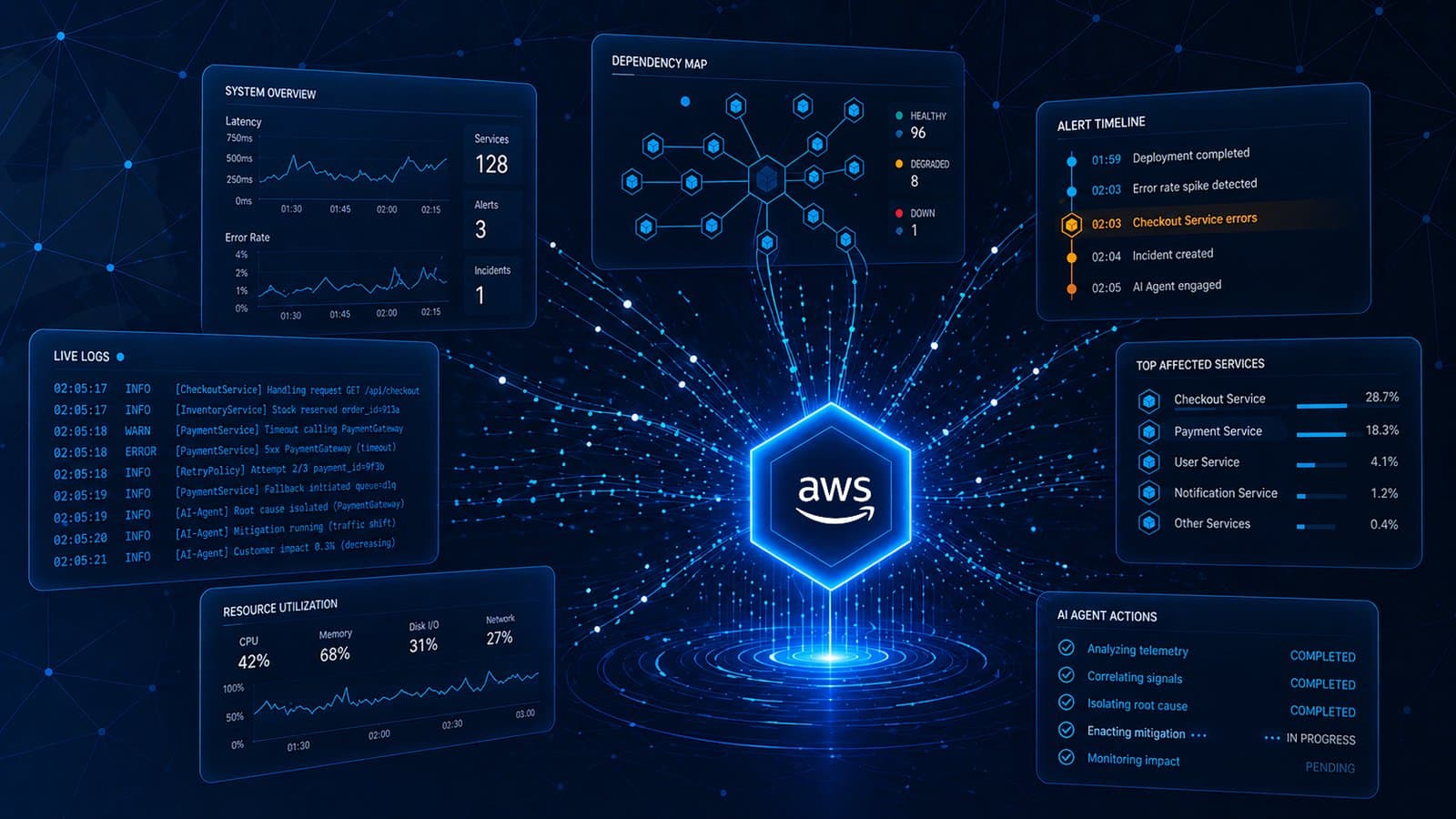
On March 31, 2026, AWS moved two of its most ambitious AI services from preview to general availability.

Why sustainability and platform engineering are the new DevOps frontiers, as cloud-native infrastructure keeps growing.